
Gold Talking Points:
- Gold has lost the $4k level and the sell-off has gained speed over the past couple of weeks.
- A major point of drive has been both high inflation and a more-hawkish Fed, but perhaps more worrying is the context with which this is all happening as stocks remain in a vulnerable position.
Gold has traditionally had a penchant for highlighting what might be ahead, such as we saw back in 2024. Even as inflation remained high a Federal Reserve talking up rate cuts highlighted that the bank was probably on the verge of diluting the currency via loose monetary policy even while price increases remained well-above their own 2% target.
The catalyst for this was a widely-watched Fed member in February of that year, imploring markets not to get ‘flipped out’ about a single inflation print that suggested they wouldn’t be able to cut. I’ve spoken of this before as that was what ultimately Fed the Gold breakout over the $2k handle, and for much of the next two years Gold prices rallied as a Fed leaned more-dovish than they probably should have.
Those tides have turned and, arguably, the Fed is now leaning far more hawkish than what one would probably expect given some of the context of the situation. Again, this morning, Christopher Waller talked up the prospect of a 50 bp hike in December. And while markets are assigning a scant 3% probability for such a move, the expectations for next year are high with anticipation of continued tightening from the Fed.
This comes as equities have been sold aggressively, fears of an AI bubble continue to percolate, and US Treasury rates have jumped back towards multi-decade highs. Collectively, this spells for a nasty backdrop for the long side of Gold but those connotations can extend across several asset classes.
Gold Weekly Chart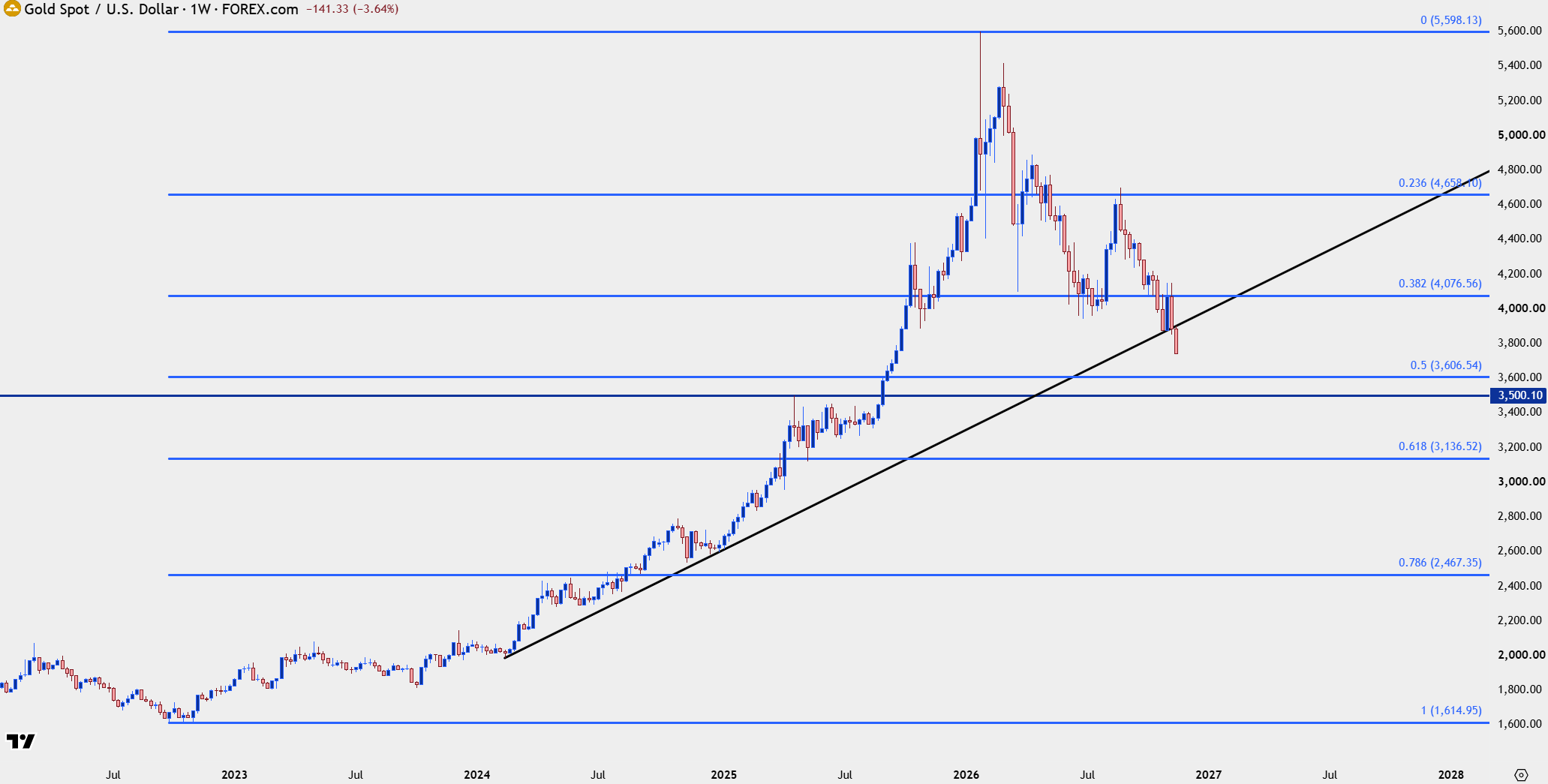
Chart prepared by James Stanley; data derived from Tradingview
Will the Fed Hike into a Recession?
It might sound outlandish to bring up the ‘recession’ word at this point as Q3 GDP growth is expected to have more than doubled from Q2, but with a Federal Reserve that’s now keenly focused on harnessing inflation, given the reverberations that has produced, the question must be asked. Also a consequence of that large jump in Q3 GDP growth is the fact that the bar is incredibly high for Q4, and a drop then sets the stage for an early-year struggle if we do see growth trend down as constrained by both higher rates and a less accommodating Federal Reserve. And judging by Gold’s price action, it seems that there could be a fit there when combined with some related matters, such as the massive run in Treasury rates that, likely, will constrain some very important pockets of the US economy.
Pending home sales, for instance, contracted by 4.7% in the release earlier today, more than doubling the expectation. This is surely a result of higher long-term rates but with a heavily indebted US government, there’s not even the prospect of austerity. And with a plethora of Treasury debt maturing in the coming year, there’s likely to be more supply which means lower prices and higher rates.
From that perspective, a recession could actually be helpful in that it would drive capital flows from equities and overbought AI stocks and into Treasuries. Of course, that would not be helpful in other pockets of the market or the economy as above target inflation for years has left a wide swath of the American economy in an already vulnerable position.
Equity markets are often a great discounting mechanism and the weakness that’s shown over the past month and change is illustrative of that fear and growing risk. And in Gold, there’s been a similar showing, although that picture is growing darker by the day as Gold prices have lost a massive spot of prior support at the $4k handle.
Gold Daily Chart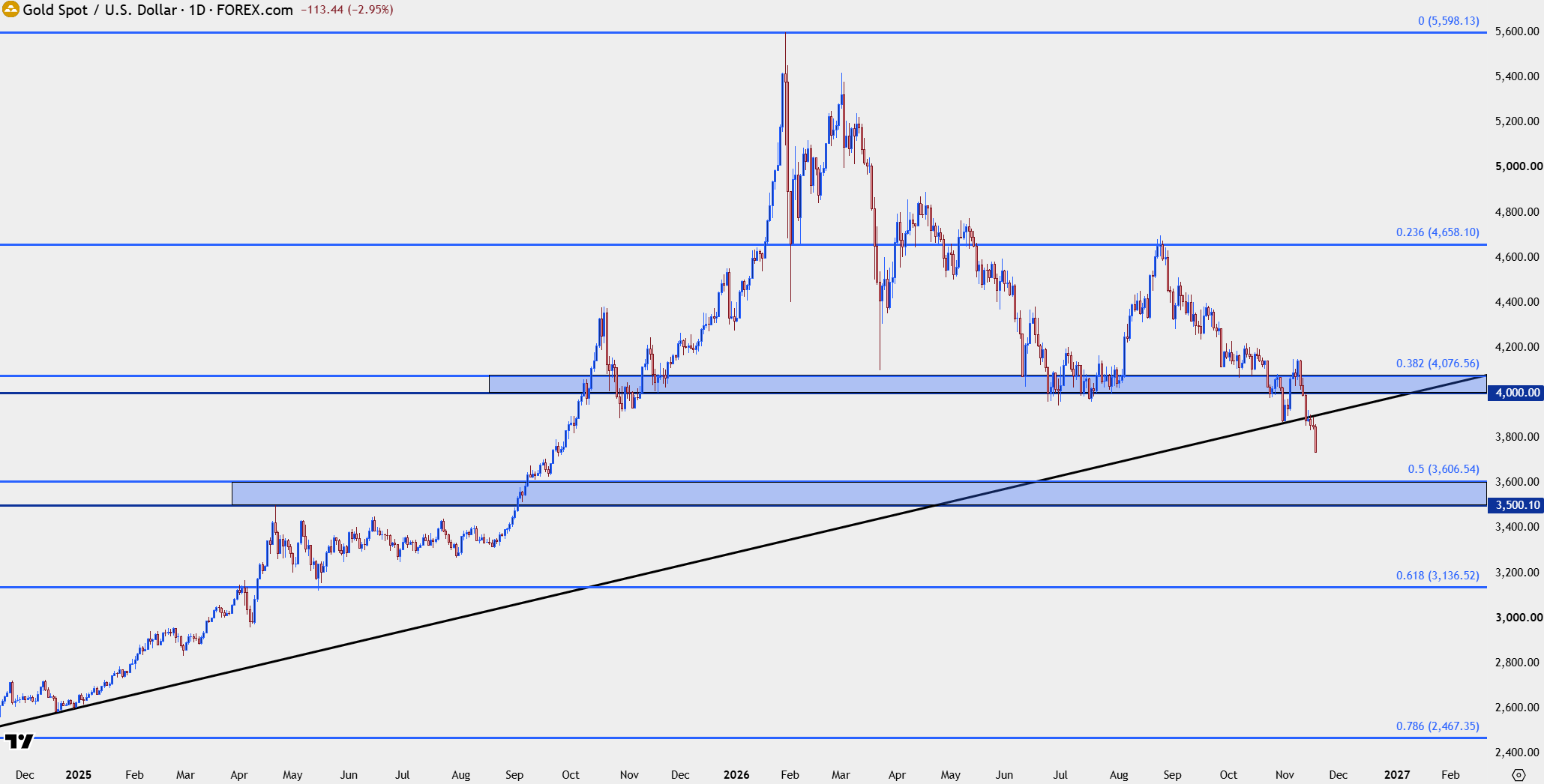
Chart prepared by James Stanley; data derived from Tradingview
Gold: The Shift
Back in June and July the world was getting to know Kevin Warsh as a new Fed Chair took over. And he probably surprised quite a few in just how hawkish he sounded, given that President Trump had spent much of the prior year both criticizing Jerome Powell and saying that whomever he selected as successor would be expected to cut rates.
That’s a very different thing than what’s happened as Warsh has already hiked rates once and as we see from expectations around the bank next year, is widely expected to hike multiple times in 2027. But, really, what’s happening now isn’t directly at the fault of Warsh as it was a Fed cutting rates while inflation was too high that built in this expectation that the Fed would not honor their mandate for 2% inflation.
That’s what’s shifted over the past few months, and that’s what shows noticeably in Gold prices as the initial sell-off after Warsh’s first rate decision atop the Fed led to the $4k test. That test lasted for almost two full months, as support held in fairly well. A breakout showed in July after Warsh and the Fed did not hike rates, but that’s all come undone over the past two months as the bank has shifted into a significantly more hawkish position.
At this point, with Gold already sliding lower, there’s not much for nearby support until we get down around the $3600 level, and just below that is the $3500 level that had held the highs for four months back in 2025, ultimately giving way when Jerome Powell signaled his willingness to cut rates at the Jackson Hole Economic Symposium (even though CPI had just printed at 2.7%, more than 35% above the Fed’s 2% target).
For lower-high resistance, the $3800 level would be considered aggressive given how close that is to price, but the $3870 level has some claim to structure as it had shown as support before this week’s breakdown move.
Gold Four-Hour Price Chart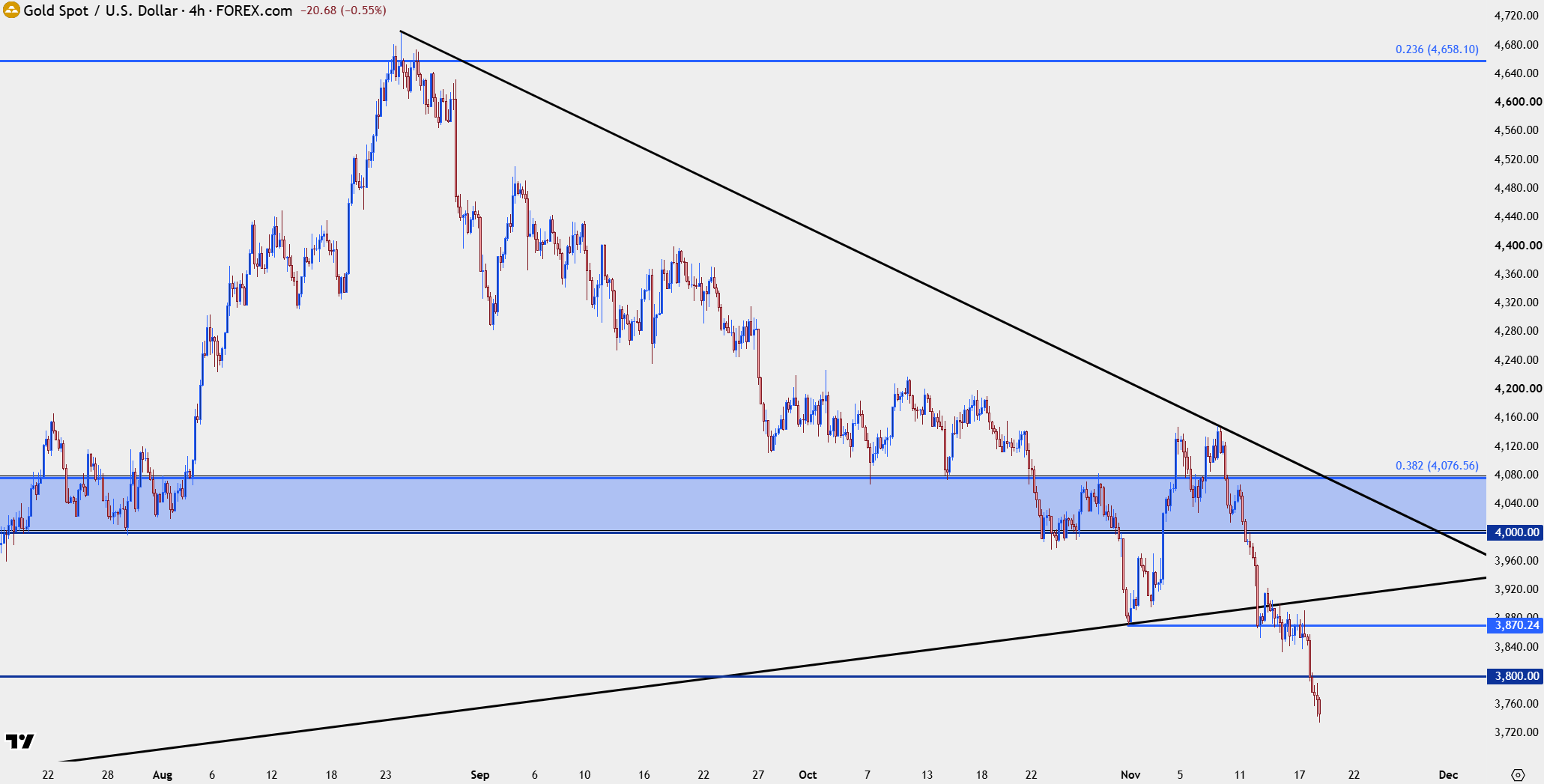
Chart prepared by James Stanley; data derived from Tradingview
--- written by James Stanley, Senior Market Analyst, Global Macro