
The dollar extended its recent advance at the start of the week, with weakness across risk-sensitive assets reinforcing demand for the US currency. US equity futures slipped ahead of Nvidia’s earnings on Tuesday and an expected stock market debut by Anthropic later this week. Both events represent important tests for an AI trade that has become increasingly vulnerable to shifts in sentiment. In FX, EUR/USD nearly tested the psychologically important 1.1000 level, before bouncing modestly off its lows. The pair faces further downside risks, although a relatively quiet US economic calendar could offer some breathing space. That said, given the underlying drivers behind the dollar’s latest advance, the prospect of a sharp break, rather than just a poke below, 1.1000 should not be dismissed. For now, the EUR/USD forecast remains tilted lower, even if we don’t necessarily expect much further downside from here on.
Dollar’s bullish momentum is strong but is it overvalued?
There is little in the current macro backdrop to suggest that it is time to call a meaningful dollar correction. The latest hawkish repricing of US interest rate expectations has been substantial, ever since Fed Governor Christopher Waller raised the prospect of a 50bp rate increase and core CPI surprised to the upside last week. Subsequent comments from other Fed officials have done little to challenge that shift. It looks like the markets are not endorsing the bigger move, but expectations have moved towards consecutive 25bp hikes in December and January. That makes sense to us. A larger hike could have undesirable effects and cause a split among the FOMC.
Against that backdrop, this week’s busy schedule of Fed speakers does not look like an obvious catalyst for a significant dollar reversal. The October FOMC minutes, due on Wednesday, are another potential source of volatility, but the recent hawkish shift in policymakers’ rhetoric and the stronger inflation reading have arguably raised the bar for a dovish surprise. The bigger threat to the dollar is therefore any further wobbles in the AI trade. Nvidia’s quarterly results on Tuesday and Anthropic’s anticipated market debut on Thursday will provide important tests of investor appetite for AI-related assets. Any sharp deterioration in sentiment towards US tech could trigger a fresh reassessment of the Fed outlook and undermine the dollar’s recent momentum.
Meanwhile, investors will also wonder whether the dollar is starting to get overvalued. With much of the hawkish repricing already reflected in prices, some dollar consolidation or short-term correction would not be surprising.
EUR/USD forecast: Hawkish ECB could limit downside
There is not much from the eurozone’s economic calendar this week, apparat from Tuesday’s ZEW survey and several ECB speakers. The ECB’s messaging has retained a broadly hawkish bias, but this has been overpowered by the Fed’s increasingly hawkish tone. We have seen a growing divergence in rate differentials as a result. While the mid-term elections uncertainty has also been lifted in the US, there the euro, in contrast, is now facing its own headwinds from heightened fiscal uncertainty across the eurozone.
That said, I think the upside is fairly limited for the dollar from here on. A sharp continuation lower in oil prices as a result of a potential US-Iran deal could see the markets unwind bets of elevated US inflation risks and price in a more dovish Fed outlook. But that is an unknown and the timing is uncertain. In the meantime, the combination of resilient US rate expectations, a relatively quiet data calendar and lingering concerns over European fiscal risks leave EUR/USD exposed.
Technical EUR/USD forecast
From a technical analysis perspective, the EUR/USD forecast is clearly bearish. You don’t need to look at any indicators to establish that; the price action alone tells the story, with the pair continuing to form lower highs and lower lows.
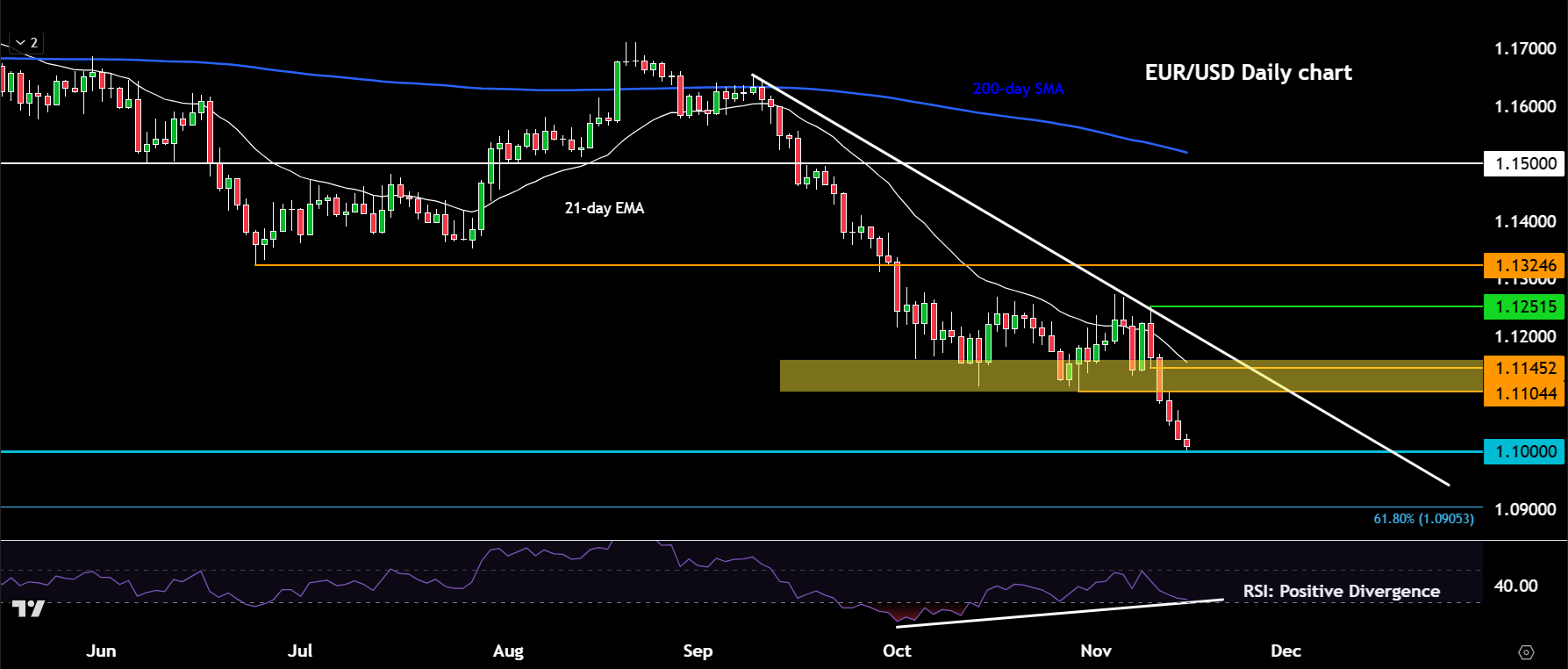
The 21-day exponential moving average is also pointing lower, as is the 200-day moving average, suggesting that both the short-term and longer-term trends are either turning bearish or are already firmly bearish on the EURUSD chart.
That said, this does not necessarily mean further downside is inevitable. Momentum is certainly negative at present, but there are signs that the selling pressure may be becoming overstretched in the short term.
Key EUR/USD levels to watch
EUR/USD is approaching an important potential support zone between 1.0900 and 1.1000. This area is significant for two reasons. First, the 61.8% Fibonacci retracement of the major rally that began in January 2025 and peaked in January 2026 comes in towards the lower end of this range, around 1.0900. Meanwhile, 1.1000 represents an important psychological level.
The confluence of these two factors makes the 1.0900–1.1000 region an area worth watching closely.
There are also some early signs that downside momentum may be fading. The Relative Strength Index is approaching oversold territory around the 30 mark. More importantly, the RSI is forming a higher low relative to its October trough, while EUR/USD itself has continued to make lower lows.
This creates a bullish divergence between price action and momentum, suggesting that the selling pressure may be losing some of its intensity as the pair approaches this key support zone.
Whether that proves sufficient to trigger a meaningful reversal remains to be seen. Until the charts provide clearer evidence of a turnaround, however, the path of least resistance remains to the downside.
Turning to resistance levels, the first important area to watch lies between 1.1100 and 1.1150. This region provided support throughout October before giving way during the early November sell-off.
It is also where the declining 21-day exponential moving average converges with a bearish trend line, adding to its technical significance.
A move back above this zone would be an encouraging first sign for the bulls. However, the more important level to watch is the most recent swing high around 1.1250. A break above that level would begin to undermine the bearish technical structure and potentially shift the short-term bias back in favour of the bulls.
In summary
So, while EUR/USD could find some support and stage a recovery from the 1.0900–1.1000 area, any rebound should initially be treated as just that: a technical bounce within a broader bearish trend. We would need to see a more convincing improvement in price action, before concluding that a more meaningful bottom is in place.